

A Wayfaring Theology of Love, Liminality, and Being Seen
by Rev’d Chantal Noppen, IC National Coordinator
The Moment of Unseeing
It began with a word my mother didn’t understand.
A word I have used for fifteen years.
A word I have referenced in a bunch of publications, bios, speeches and talks.
A word I came out with in a conversation I had taken ages to build up to, that she has now forgotten.
A few weeks after I shared my 2026 General Synod election address, she brought up, ever so casually that there was a word I’d used that she didn’t understand. The word was “Queer”, she asked what it meant. I asked what she thought it meant, her guess: “Well it usually means you’re transexual doesn’t it?”
There is a particular ache in realising someone who loves you has not perceived what you’ve said plainly, repeatedly, publicly. Not through malice, but through narrative‑filling estimation. Through deafness, literal and metaphorical. Through the human habit of hearing what we expect rather than what is actually said.
Perhaps that is why words matter so much. We use them because we want to be understood. We search for them because sometimes finding the right word feels like finding a piece of ourselves. We name things in order to make sense of them, to communicate what we experience, to find others who recognise it too. We want to be known.
But words can only ever take us so far, we know they will fall short. No word contains the whole of a person. And the same word that can liberate when we choose it for ourselves can become a limitation when someone else decides what it means about us.
And so this reflection sits in the gap between being known and being assumed, between being loved and being unseen. In the space where language fails, and identity waits patiently to be recognised. It’s not a piece pitching for access to be granted to LGBTQ+ people into the holy grail of marriage. It’s an inhabiting of being known and finding a voice in the void.
I am married. I didn’t expect to be. It wasn’t something I’d oriented my hopes around or assumed I would experience. And getting married, felt to me to almost be a betrayal. Because why should I have access to something so many were denied, simply because I happened to find someone able to tick the boxes offered? It wasn’t, isn’t fair. And it feels like denying a part of myself, simply to to avoid some people’s discomfort.
This is the space I call queer.
The Wayfaring History of a Word
The word queer has always lived at the edges. While words cannot contain the whole of a person, they do offer voice to the invisible, helping us to communicate experience, recognise ourselves, and build community. Communities claim ownership of words, they create language. And language changes as our needs shift.
In the 16th century, queer meant strange, odd, eccentric, a descriptor for anything that, with or without provocation, didn’t fit neatly into expectation. It later became a slur, sharpened into a weapon in the late 19th century, hurled at Oscar Wilde and countless others. And then, through pain and protest, it was proudly reclaimed, shouted in defiance by activists during the AIDS crisis: “We’re here, we’re queer, get used to it.”
Today, queer is expansive. It is an umbrella, a home, a refusal to be boxed in.
It acts as a rejection of rigid binary categories, even as some still hear its older echoes. Its uncomfortable nature, the fact it divides people and is emotive, is part of its power and its beauty.
But for me, queer is not only historical. It is theological.
The Poem That Named Me
In my second year at theological college I was blessed with the opportunity to go on exchange for a semester. And so I found myself at Yale Divinity School, where I found that the shared language I thought we had, was in fact not the same at all. The same words were used perhaps, but it was a different language, used in a different way. There were words I discovered there that I hadn’t found at home. And finding those words, led to me finding myself. To uncovering a language within which there was an articulation of self that fitted. The years of feeling that my sexuality wasn’t clear to me, my self a bit obscured, the options available, or at least existing on my horizons, not right. Here, in queer, was a new known. It’s mattered to me for a long time to be able to communicate who I am.
During ‘coming out week’ I managed to express this journey and discovery on paper, in poetry:
This I Know
I believe in love,
Not confined or defined by gender or sexuality.
Souls are colourful beautiful things
And they are what I love in people.
Perhaps this sounds idealistic
Or even indecisive,
Maybe it is, but love hurts.
It challenges, upsets and comforts
Simultaneously.
This I know.
If you assume you know who I am,
You don’t know the full picture.
Don’t try to label me,
There is an exception to every rule and boxes don’t come that size.
But if it makes you happier to know,
I believe you can call me Queer.
This poem wasn’t a defiant youthful declaration.
It was, and is theology. Identity. Belovedness. And the seed at the root of everything.
I am autistic. I also have ADHD. I put a lot of effort into understanding and being understood. Justifying, describing, reasoning, thinking, planning, rewriting. I also take a lot more thing literally than I realise, and I am inclined to believe that if I have said something plainly, it will be heard, understood and valued. This is a faulty premise. Yet it is also deeply, humblingly human.
I am a better person, a better Christian, because I have allowed myself to recognise that queerness doesn’t need to be separated from belovedness. They can be together, they are connected. Alienation, separation and exclusion are not where blessings live. It is always in relationship, in community, that we feel, find and flourish in God. That love refines us. That is the way it’s meant to be.
And a narrow set of rules, regulations and assumptions about who, what, when and where things fit together, doesn’t actually increase holiness and reduce sin. But it does allow shame to take root, and grow.
Queer Theology: Dwelling in the Liminal Godspace
Queer theology begins with a simple, disruptive premise:
God is not afraid of the in‑between.
Christianity has always been a faith of thresholds; creation out of nothing, incarnation that is both human and divine, sacraments that are both material and spiritual, resurrection that is both body and mystery. The tradition is full of liminal spaces. A truth I feel particularly keenly as a Church of England priest, there the broadness of our church means the ‘both/and’ is basically a touchstone for everything!
To be queer is to live comfortably, or at least honestly, in those thresholds. There’s a courageous authenticity recognising it resonates in your being.
Queer theology refuses the neatness of binaries. It resists the temptation to collapse complexity into certainty. It recognises that God’s creative work often happens in the places where categories blur, boundaries smudge, and identity refuses to be pinned down. The messy places, the wilderness, the unknown. The mystery.
This is not a departure from orthodoxy.
It is a return to the God who creates ex nihilo, out of nothingness, out of liminality, out of the vast cosmic “in‑between” that makes up 99.999% of the atom. The simple, yet mind shattering paradox of realising that God is able to out of nothing, bring everything. Boom.
Queer theology asserts that we should not limit God, nor assume that God doesn’t inhabit the in-between. There is nowhere that God is not. And if God dwells in the liminal, then so does love. Sanctifying beyond the binary.
Queerness becomes a spiritual discipline:
- a way of seeing the world with curiosity rather than fear,
- a way of embracing mystery rather than demanding certainty,
- a way of widening compassion rather than narrowing belonging.
It is not about sex.
It is not about rebellion.
It is not about rejecting tradition.
It is about expansion: to broaden the compassion, widen the doorway and smudge the boundaries. Inhabiting and exploring a reality of an incarnational faith.
It is about recognising that belovedness is not a reward for conformity, but a condition of existence.
It is about trusting that God meets us not at the edges of acceptability but at the fringes of ourselves. Or, to lean into a metaphor, at the hems of our being, where we turn up…
Belovedness: The Thread That Holds Everything Together
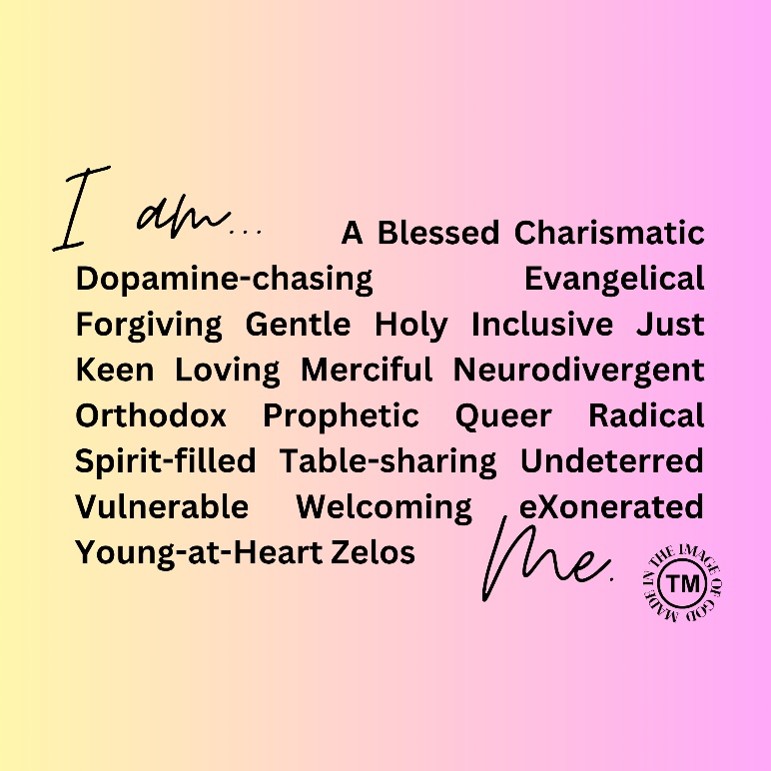
I cannot detach queer from beloved. Because the moment I found the word queer, there was a peace that settled into my soul far more than most other revelations.
It wasn’t just identity. It was recognition.
It was God. And thus, it was love.
Because my lived experience of God has always been one of unconditional love. All the fear, doubt and shame has been from the church. Not from God. Never from God.
To be queerly beloved is to know that God’s love is not contingent on conformity.
It is not limited by sexuality, gender, disability, or neurodiversity.
It is not threatened by difference. It is not afraid of complexity.
Sin, in this framing, is not about rule‑breaking. But rather about disconnection and distance between us and God. Sin is not made less serious by moving the conversation away from rule-breaking and towards relationship. In fact, it becomes more serious because now greed, domination, contempt, exploitation, vanity, exclusion, abuse, dishonesty are no longer ignored. Queerness, then, becomes a movement towards God, a reclaiming of identity, a healing of shame, a widening of love.
The AuDHD Lens: When Words Don’t Land
But life being ever like an onion, there’s another layer to this story: the AuDHD experience of communication.
As a Northern, autistic half-Dutch person, I definitely tend to err on the side of direct talking! So it always throws me when I realise that despite me literally saying the thing plainly, it hasn’t been perceived, caught or recognised. Each and every time this happens, I am shocked.
It is frustrating and bewildering when a loved one fills in their own blanks instead of hearing your truth. Allowing your story, to be told, in its own words.
Language is slippery. Words mean different things to different people. For someone who processes the world through precision, curiosity, and constant learning, the mismatch can feel like a rupture.
But it also illuminates why queer matters:
- It gives language to the in‑between.
- It names the space where misunderstanding happens.
- It honours complexity rather than erasing it.
For someone who lives with the constant tension of being autistic yet also having ADHD, queer fits, precisely because it doesn’t fit.
The problem is that people attach meanings and assumptions to labels. They act like additional descriptors and behaviours are a given because of one applied aspect. Which is never the whole picture. When we do this, as my mum did, as society does and the church has a history of doing, we diminish the beautiful reality of being fearfully and wonderfully made.
Queer Marriage: Reframing, Reclaiming, Reimagining
The conversation around LGBTQ+ inclusion often gets stuck on marriage, as though marriage were the pinnacle of relational holiness, the gold standard of intimacy, the final destination of queer liberation. The ultimate prize everyone must be striving to attain.
I don’t really understand how we’ve got there, or indeed, why we are still there. Because marriage, historically, has been messy.
Patriarchal.
Transactional.
Often harmful.
Used to distract, deny and justify horrendous misery and subjugation.
Marriage is the wrong thing to get hung up on. It needs to be taken off its damn pedestal. Unless we’re willing to do the hard graft of redefining what we actually mean we want marriage to be.
Marriage does not, cannot, define love. It should be the other way around. We need to untangle our hang-ups, misunderstandings and fears about sex and become far bolder about the life-giving possibilities of relationships and the centrality of love to them.
Queer theology reframes marriage not as an institution to be defended but as a relational practice to be liberated.
It asks:
- What if marriage were not about sex?
- What if procreation were not its proof of validity?
- What if marriage were not about conformity?
- What if it were not a tool of gatekeeping?
What if marriage were about intimacy, as the deep vulnerability, trust and knowing that can exist between people in all sorts of relationships? Sex can be intimate. But intimacy is not synonymous with sex. And some of the most profound forms of human intimacy are not sexual at all.
What if marriage were about:
- – fidelity as mutual commitment,
- – intimacy as shared vulnerability and deep knowing,
- – trust as spiritual practice,
- – honour and respect as currency,
- – companionship as sacrament
These are not heterosexual virtues. These are human virtues, divine virtues.
Queer marriage, or more accurately, queer relationality, invites us to imagine relationships that are not constrained by tradition but animated by love: covenantal without being hierarchical, intimate without being sexual, faithful without being possessive, loving without being limited.
Let us not fight for scraps of what marriage has been.
Let us expand marriage into what it could be.
Let us reimagine not a static target or trophy displayed on a pedestal but a dynamic, reactive, evolving contextual practice, and, crucially, one of many ways humans can embody God’s relational nature.
Queer theology and a queer reframing of marriage both ask the same question:
What happens when we stop policing boundaries and start honouring belovedness? When we make it about love rather than law?
Wrestling Like Jacob: The Character of Hope
Faith is not static. It is restless, till we find our rest in God.
To be queerly beloved is to wrestle, like Jacob, and to walk away blessed, even if limping. It is to trust that God is bound up with creation, which means growth, change, and sometimes pain.
But always love.
Hope is wayfaring. It moves. It wanders. It expands.
Queering our assumptions, our theology, our language is not rebellion.
It is revelation.
My mum isn’t a bad person for forgetting something about me that was of such importance. She has already had her horizons expanded, and she is more aware there is more she hasn’t understood. Hopefully she will ask. Hopefully she will hear.
Maybe she will find new words for herself too.
A Final Word: Liberating Belovedness
There is something radically transformative about owning your truth. To be able to unfurl and walk tall because we know we are loved.
Queerly Beloved is more than a title. It is a prayer. A proclamation. A promise.
God is love. God will always be, with us, for us, in us. That truth liberates, defines and refines us. And should be all that matters, really.
But if it makes you happier to know, I believe you can call me Queer.
And I am Queerly Beloved.
Endnotes & additional reading
- Historical development of queer: see linguistic histories from La Trobe University and activist accounts from Queer Nation.
- See https://www.historyisaweapon.com/defcon1/queernation.html for a quite long, and brutal, queer nation manifesto, worth reading all the way through.
- “We’re here, we’re queer, get used to it” — Queer Nation, 1990. Also see examples of the use of humour in the reclaiming https://www.kqed.org/arts/13858167/queer-nation-lgbtq-activism-90s
- Ex nihilo – a foundational theological and philosophical doctrine of creation, meaning ‘out of nothing’.
- St Augustine, Confessions 1.1.1. — “restless till we find our rest in God.”
- “Christian” used originally as a slur, see Acts 11:26.
- This I Know Noppen, (Yale, Coming Out Week 2011) primary source.
- Queer relationality explored by theologians Patrick Cheng, Carter Heyward, Marcella Althaus‑Reid. Carter brings a particularly valuable intersectional approach of a feminist perspective and gender oppression.
- Liminality notably explored as sacred space by Scottish anthropologist Victor Turner. Turner’s ‘normative communitas’ theory is particularly relevant.