

IC Trustee & Disability lead Emily Richardson says:
One of the best parts of the Inclusive Church year is the annual Disability Conference, held in partnership with St Martin-in-the-Fields. I may be biased, being part of the planning team and a trustee of Inclusive Church but it is a space like no other.
Since 2012 we’ve been holding space for Deaf, disabled and neurodivergent people to gather, to resource each other and the church. It’s a space created for disabled people and by disabled people. It’s a gathering to learn, discuss, to celebrate, to lament. For some, we know, it is their only experience of church in the year. As one of our past attendees, Sarah, described it: “the one place where I don’t have to leave a part of myself at the door, like a pair of dirty boots.”
the one place where I don’t have to leave a part of myself at the door, like a pair of dirty boots.
past attendee, Sarah



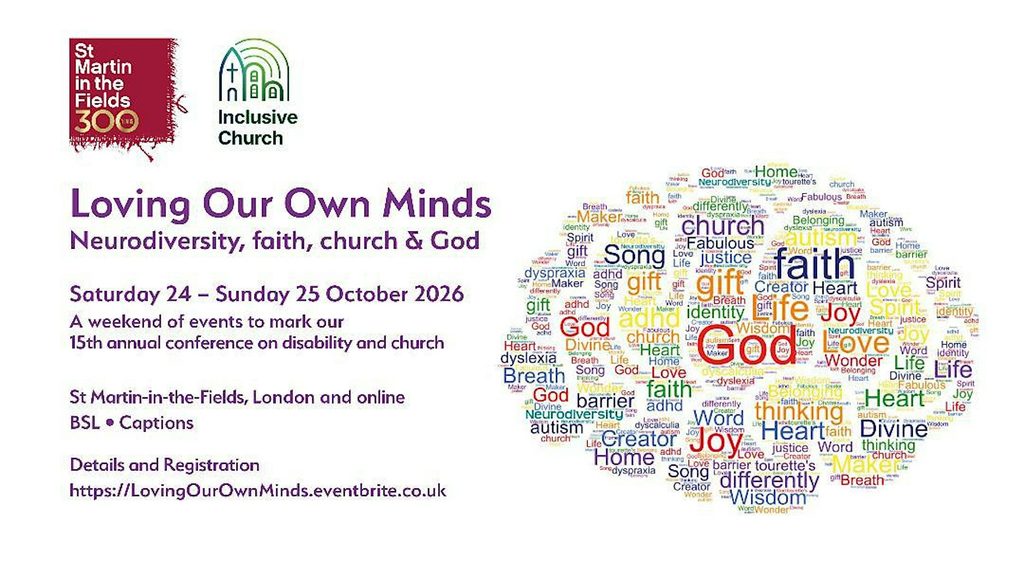
Our 15th annual conference focuses on Neurodiversity, faith, church and God, and explores how to learn to love our own minds. We began a part of this conversation in 2019 with our first conference focussing exclusively on neurodiversity, Thinking Differently About God. Now we’re exploring these ideas once again.
Neurodiversity is the idea that there are natural variations in the way people think, sense and experience the world. These differences include autism, ADHD, dyslexia, dyspraxia and Tourettes – each a combination of strength and difficulty. The church and society can be difficult places for those who think differently. We’ll share ideas of faith, church and God and of learning to love our own minds.
Speakers, storytellers, worship and workshop leaders include: Nat Clayton, El Dewar, Andrew Dowsett, Sue Hartley, Naomi Lawson Jacobs, Ayla Lepine, Ellen Louden, Fiona MacMillan, Emma Major, Maddie Naisbitt, Rachel Noel, Chantal Noppen, Zoe Strong, Rachel Summers, Leon van Ommen, Krysia Waldock, WAVE for Change, Sam Wells and Simon Young. Final contributors TBC
At her Synod address during the neurodiversity debate in July 2026, the Archbishop of Canterbury argued ”Neurodiversity is not a problem to be solved within the church, but it is a gift. It is important that neurodivergent people within our church are not only functioning but flourishing.” We hope that in October we can find ways to enable that flourishing. We’d love to have you join us!
In conversation with Fiona MacMillan
Neurodivergent trainee Methodist minister and musician Paul Coleman was tasked with interviewing Fiona about the work that’s integral to the conference, IC’s work and progress in the Church of England around affirming neurodiversity…
In July 2026, the Church of England’s (CofE) General Synod held its first-ever debate on neurodiversity, unanimously passing All Kinds of Minds: affirming neurodiversity in the life of the Church. The motion recognised neurodivergent people, lay and ordained, as “lovingly and purposefully made” and as a blessing to the Church and wider society. It called for the national Church to identify changes to structures and processes which offer barriers preventing neurodivergent people from flourishing, for neurodivergent-led training, for a national network of diocesan (regional) Neurodiversity Champions and for local churches to listen to the experience of neurodivergent people in their own communities
I spoke to Fiona MacMillan, a former Inclusive Church trustee who chairs the CofE’s Neurodiversity Working Group and who presented the motion. Fiona has been involved in disability and church work since initiating the first disability conference in 2012, a partnership between St Martin-in-the-Fields and Inclusive Church. Fiona emphasised that these conferences are centred on lived experience, for rather than about Deaf, disabled and neurodivergent people, who shape the planning, speaking and participation.
Much of our conversation came back to the language at the beginning of the motion. Fiona described neurodiversity as a “positive paradigm” and a “strength-based approach” – one which moves away from a focus on what minds cannot do. For Fiona, it’s important that the CofE has endorsed neurodiversity, working for a Church in which “all kinds of minds can flourish”.
That raises questions which go beyond adjustments on a Sunday morning. Quiet spaces, lighting, accessible materials and freedom to move are important, but Fiona pointed towards ministry, theological education, leadership and the expectations built into church structures. As Fiona put it, “It’s about thinking differently about God and about church and about worship and about community.”
We also talked about whose voices are most likely to be heard. All Kinds of Minds was supported by qualitative research into the experience of neurodivergent church leaders, people who have already managed to navigate church structures to some extent. Fiona acknowledged that, while arguing that if neurodivergent leaders are struggling, how much more will this be the experience of people who have found those structures much harder to enter at all.
The conversation moved towards Loving Our Own Minds: Neurodiversity, Faith, Church and God, the 15th annual conference which will take place on 24 and 25 October. The conference is ecumenical, rather than just Church of England. Fiona described it as a place where Deaf, disabled and neurodivergent people can come together and resource one another, then go back and resource their own churches and communities. Fiona hopes people will leave “having learned to love our own minds a bit more”.
For local churches, there is no need to wait for every national structure to be in place. Fiona’s advice was to start by listening to the people already there, to get a sense of what is working and not working for them, offering different ways they can respond and suggest what would work better. There is, as Fiona said, “no one-size-fits-all”.
Near the end of our conversation Fiona summed this up in a way which brings both the motion and the conference together:
“There’s something really key for churches in learning to listen to lived experience and in embracing the gifts that the Church has already been given. God has already sent what we need to renew the Church: we need to listen.”
There’s something really key for churches in learning to listen to lived experience and in embracing the gifts that the Church has already been given. God has already sent what we need to renew the Church: we need to listen.
MacMillan
If you’re interested in learning more about Neurodiversity, the challenges and blessings, resources and support available, we’ll be sharing more soon!