
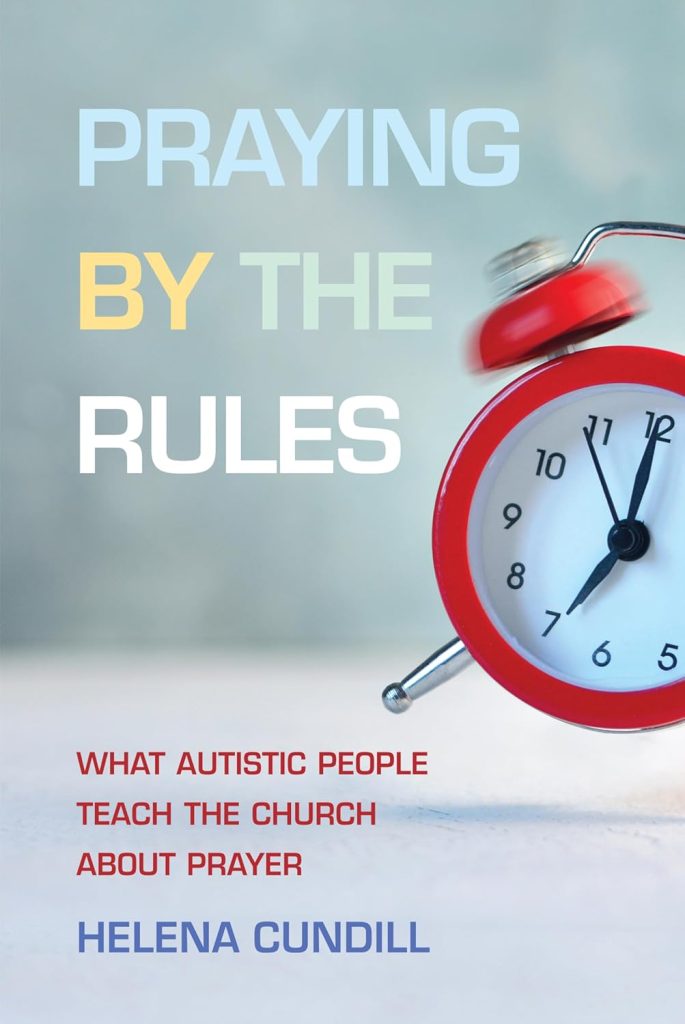
Book review: Cundhill (SCM Press)
With my thanks to the member who shared this thoughtfully considered, yet personal, review.
Praying by the Rules is an adaptation and expansion of Helena Cundill’s doctoral research into the prayer practices of a group of Autistic Christians. Through qualitative interviews, Cundill explores the anxieties many participants experience around prayer and considers how the Church might better support Autistic people in developing authentic, life-giving spiritual practices.
As an Autistic Christian with longstanding special interests in both prayer and autism, I found this book deeply engaging. I recognised many of my own experiences in those of the participants and finished it with a profound sense of being seen. More importantly, I was reminded that I am not alone in navigating questions about what it means to pray authentically.
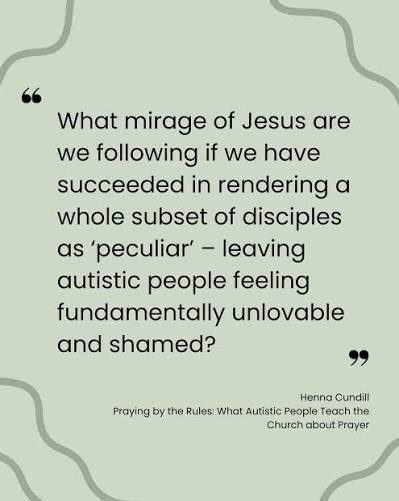
One of the book’s central concerns is the way churches often present ambiguous, neurotypically coded approaches to prayer as the implicit ideal. The resulting shame experienced by those who struggle to conform is explored with both compassion and theological sensitivity. Several participants express a longing for clear rules—wanting to know what they must do to pray “properly” or to be “good enough” before God. Cundill examines this desire thoughtfully, asking not only why such certainty is sought, but also what prayer fundamentally is and whether it should be governed by rules at all.
The book ultimately commends the familiar wisdom: “Pray as you can, not as you can’t.” While I appreciate the pastoral intent behind this conclusion, I found myself wishing it went further. It can still suggest that there is an ideal form of prayer which some people are simply unable to attain. Personally, I would have welcomed a more explicit rejection of the idea that there is any universally “right” or “wrong” way to pray. I find greater freedom in St Paul’s principle that “all things are permissible, but not all things are beneficial” (1 Corinthians 10:23), which allows for genuine diversity without establishing a single normative model.
The sections on intercessory prayer resonated particularly strongly with me. Several participants describe the anxiety of wondering whether they are praying for the “right” things or praying “enough” to fulfil their responsibilities before God. I recognised this immediately. As a younger Christian, I carried an overwhelming sense of responsibility to pray those around me “out of hell” and “into heaven”, and the burden of feeling that someone else’s eternal destiny might depend upon my prayers became a significant source of anxiety.
I also found myself identifying with participants who were drawn to liturgical prayer because of its clear structures and expectations, as well as with those who practised silent prayer and moved beyond anthropomorphic images of God. Perhaps the book’s most significant gift to me, however, was helping me recognise that I am often non-verbal in prayer, and that this too is an authentic way of praying. My use of prayer beads, for example, allows me to “pray with my fingers” rather than with words. Rather than seeing this as a deficiency to overcome, I have come to recognise it as one of the ways God is inviting me to pray. Reading these accounts even led me to wonder whether Autistic Jews praying at the Western Wall might similarly experience swaying as a form of non-verbal, stim-based prayer.
Although much of the book examines the damage churches can inflict by idealising “prayer as conversation” and other neurotypically coded assumptions, it is ultimately a hopeful work. Prayer emerges as a place where Autistic Christians can safely unmask before God, trusting that God is omnilingual and speaks “Asperigan”. Before such a God there is no need to perform, translate or conform. We are welcomed, understood and delighted in exactly as we are.
If I have one substantive criticism, it is that the book’s subtitle—What Autistic People Teach the Church About Prayer—promises a more explicit argument than the book itself delivers. The insights are certainly there, but readers are often left to draw them together for themselves. My own reading is that Autistic experiences expose just how dependent many churches are on unwritten social rules enforced through shame. In doing so, they also point towards a richer vision of prayer: one grounded not in performance or conformity but in authenticity, trust and grace.
Ultimately, Cundill offers something richer than simply a critique of neurotypical assumptions. She invites the Church to rediscover prayer as a place where every person may come before God without pretence. For me, that meant letting go of the pressure to conform to a false image of a “neurotypical Jesus”. Instead, I am learning to recognise that Christ meets me, and is revealed through me, precisely in my autistic way of being. If autism is part of how God has created me in the imago Dei, then it belongs not at the margins of my spiritual life but at its very centre. We are each irreplaceable members of the body of Christ, and God’s desire is not uniformity but communion in our God-given diversity.
This is an important and thoughtful contribution to the growing conversation around autism and Christianity. While I would have welcomed a more radical affirmation of neurodivergent expressions of prayer, I found the book both pastorally sensitive and theologically rich. It challenged me, encouraged me and, perhaps most importantly, gave me a new framework for understanding my own life of prayer.