

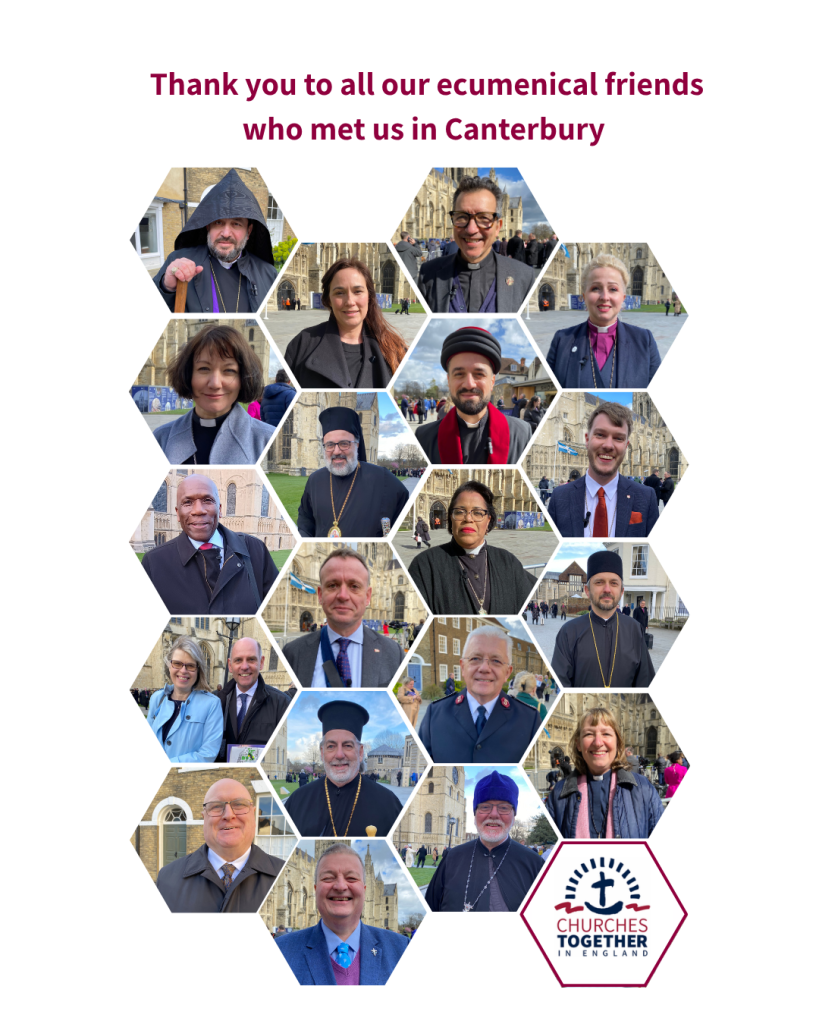
One of our Inclusive Church Trustees, Sarah Ball, Communications lead for Churches Together in England, was in Canterbury for the installation of Archbishop Sarah. We asked her to share her experience with us…
When I say I was ‘in Canterbury,’ I mean in the city, not the Cathedral. My role that day was to stand in ‘press pen’ with the broadcast media and photographers and to observe and interview the guests before and after the installation ceremony.
My ‘pen-mates’ from the BBC, Reuters, ITN, the Press Association, GB News and several international outlets were keen to capture the arrivals of politicians, ‘celebrities’ and in particular the Prince and Princess of Wales.
I, on the other hand, was looking out for leaders of the 53 other Member Churches (alongside the Anglicans) that make up Churches Together in England. I was also trying to spot ecumenical guests from the World Council of Churches, the Vatican, the World Methodist Council, and the Lutheran World Federation.
The story I was there to tell was that people from across the full spectrum of church traditions were gathered to see Sarah Mullally answer God’s call to be the 106th Archbishop of Canterbury.
I spoke to Orthodox Archbishops, Vatican envoys, Eastern Church Primates, Quaker representatives, a Salvation Army Colonel, Free and Reformed church leaders, and each of them said the same – they felt privileged to be there on 25th March. And so did I.
We witnessed history being made. The new Archbishop is a state-school-educated woman. She did not go to Oxbridge, and she used to do a ‘real job’ outside church structures. She is dyslexic. All of these are mould-breaking for the leader of the Anglican Communion and, I feel, all profoundly encouraging for supporters of Inclusive Church.
The entire day felt joyful. For Christian unity enthusiasts like me, the spontaneous hugs exchanged with the other Presidents of Churches Together in England after Archbishop Sarah signed the Ecumenical Covenant were significant and hopeful.
My prayer is that these Presidents, which for the first time contain equal numbers of women and men, and of white and non-white leaders, will usher in an era of fruitful joint Christian witness in a country that feels increasingly divided and badly needs it.
You can view the Churches Together in England ‘highlights reel’ here