

After 35 years as a London vicar, Richard Dormandy now writes and makes music from his home in Soham. Here he reflects on how we illuminate and develop our faith.
“We just need to simplify it,” he said. “There’s too much to take in.” A good-hearted member of the congregation had come to see me about my vision for the church.
In truth, the whole idea of me having a vision for the church had never sat easily with me, since I had always operated with the idea that it was our vision, and that we would discover it together. Nevertheless, I had eventually come up with a vision that expressed what we were about, and the Church Council had accepted it.
“Can you narrow the focus?” he asked.
The thing is that people crave a narrow focus. I remember the giddy experience of discovering, at A-Level, that everything we’d learnt at O-Level was far too simple. The sensation was repeated when I did my Degree. Dealing with complexity required greater self-confidence, but normally this produced a virtuous circle of growth. Yet business, politics, culture and church seems to thrive on what is narrow – and the apparent certainty that flows from it.
I said to my friend, “Picture a huge light with a fader that you can control. In this particular case, the fader doesn’t simply make the light dimmer or brighter. In this case, the fade affects the breadth of the beam.”
“OK,” said my friend.
“When I bring the fader fully down, we have a laser beam: immensely bright, scorchingly hot, able to burn a line through sheet metal. Everything around the beam is in darkness. The laser commands our total attention, and there’s not a shred of doubt as to its direction. You may wonder what lies to left or right of it, but there’s no point even trying to see. If you were looking to follow the light, you would be very careful. You’d sense that if you got too close then you might be burned up and burned out; on the other hand if you didn’t follow close enough, you could go spiralling off into the outer darkness. The laser beam is attractive because of its clarity and apparent power. But it can also be very dangerous.
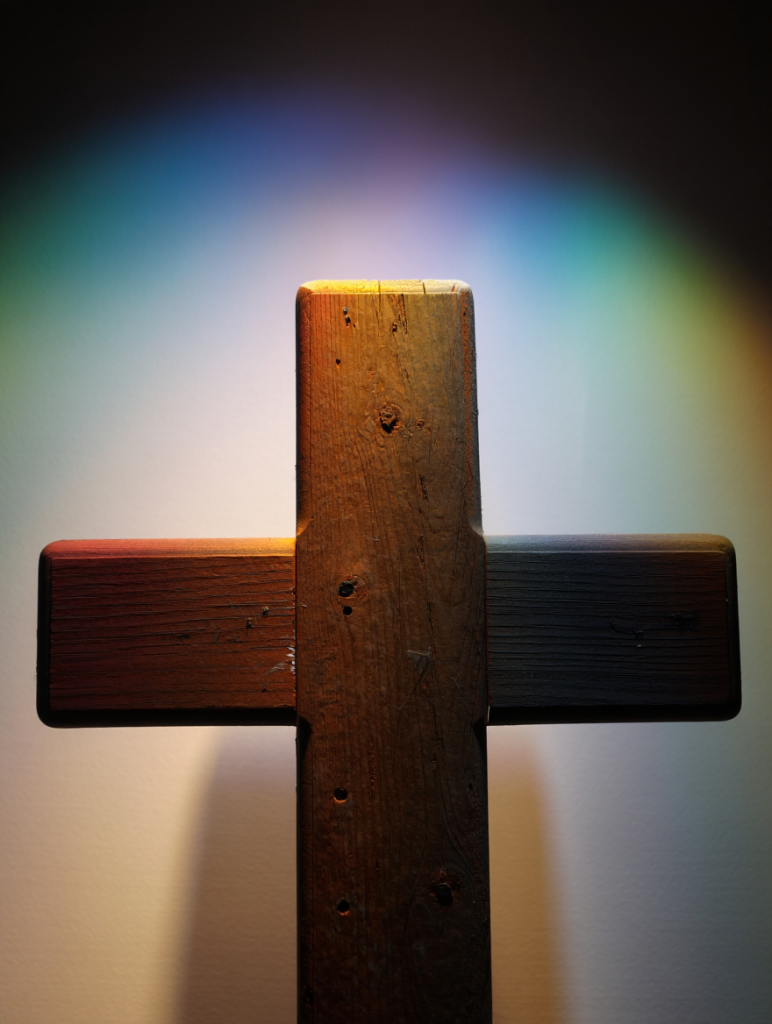
But when I bring the fader fully up, we have a flood light. Understand me correctly, it represents exactly the same amount of power – but the beam is spread out wider. Now we see the whole landscape. We have to think a bit more about where the path lies, but we do have the ability to work it out, so what we actually need is the confidence to grow. The light is much gentler, enabling us to see things for ourselves, and to explore. Our anxiety about falling into the abyss has dissipated. It’s not that we no longer trust God, but we’re also learning to trust ourselves as adult human beings. As we take in the bigger picture, we can still see the best way forward – in fact we might see a number of variations of that best way as we each discover our own particular path. Whereas the laser commanded only obedience, the flood light brings understanding.
“There is a time and place for the laser,” I told my friend. “But I think that as adult disciples, we need the fulness of God’s power to be spread as the flood light. This is the maturity that I hope our church can attain.”
When I spoke these words, some twenty-five years ago, I hadn’t thought them before. Today, with the rise of narrow-beam ideologies and “hard-line” teachings, I feel we need the flood beam more than ever – to see, to understand, to appreciate, and to grow in true confidence. Living in the broad beam doesn’t mean we flock mindlessly to what Jesus called the “broad path”. On the contrary, while others may flock to surge behind the laser, we grow in maturity to discern God’s true path.