


We Are Here
Introduction
We Are Here starts from a simple fact:
We are here.
Through photographs, participants’ own choices about representation, and anonymous summary information, We Are Here offers a glimpse of the breadth and diversity of LGBTQIA+ presence within the Church of England’s General Synod. It does not seek to discuss theology, specifics of relationships or personal circumstances. Rather, it offers a simple reminder:
We are here. We always have been.
We are clergy and lay people. We are parish priests, readers, chaplains, academics, parents, spouses…
… grandparents, campaigners, administrators and volunteers. We sit in Synod. We preach, teach and lead. We ‘hatch match and dispatch’. We serve coffee, reconcile finances, cut the grass. We do the ordinary work of being the Church. In community, shared lives of faith are lived and embodied. Seen. Named. Known. Affirmed.
Too often, conversations about LGBTQIA+ people take place as though we are an abstract issue rather than members of Christ’s body. This account seeks to offer something different: a glimpse of some of the LGBTQIA+ General Synod members who have faithfully served, prayed, led and loved the Church throughout the 2021-2026 quinquennium.
The report was intentionally focussed on visibility and participation rather than theological position, relationship status or personal circumstances. Together, the contributors represent a wide range of identities, experiences, traditions and viewpoints. There is not a single perspective, but a shared reality:
We are here.
This account began as a seed of an idea during the final stages of the 2021-2026 quinquennium, following debates that served as a reminder of the importance of visibility, presence and community. After five years of serving together, friendships had been formed, support offered and community built. As one Synod gave way to the next, it seemed important to capture something of the people who had been part of that journey. The idea lingered, refusing to go away, and over the weeks that followed gradually took shape into the project you see here
The individuals represented here are only a small part of a much larger story. They cannot speak for every LGBTQIA+ person in the Church, nor do they try to. But together they offer a visible reminder of a truth that often becomes lost in debate:
We are here. We have always been here. This is our church just as much as anyone else’s.
We hope this project will encourage others to recognise, celebrate and remember that fact.
The main narrative report…
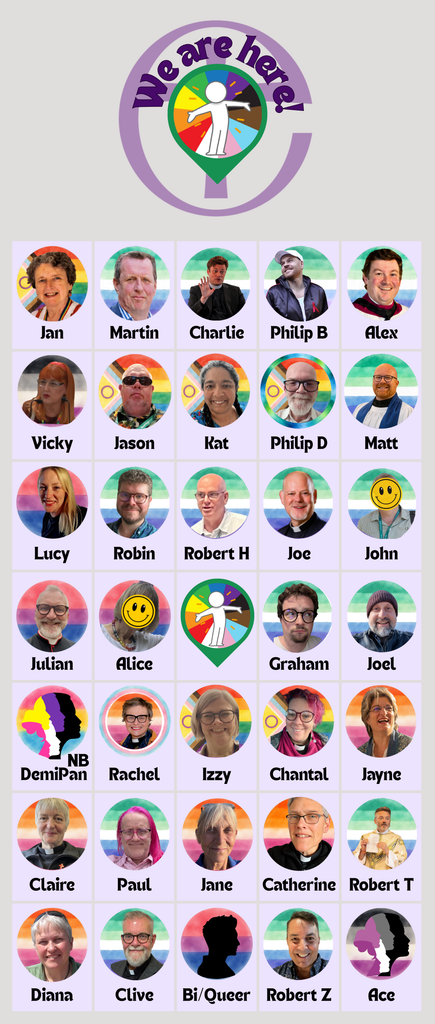
For too long, LLF debates and Synod discussions have spoken about LGBTQIA+ Anglicans as if we were not in the room. But we are here.
We are not abstract concepts, theological problems, or hypothetical case studies. We are real people with faces, names, and stories. We have always been here.
And we are not few.
This summer, at the final sitting of General Synod, there was an opportunity for a pastoral response and acknowledgement of LGBTQIA+ people: a response that sought to recognise our worth and affirm our existence. It didn’t seek to discuss, determine or define sex, marriage or relationship status. Yet it was insinuated that this would be the inevitable consequence and there was a distinct air of fear that a simple affirmation might cause no end of problems.
We have sat and been discussed like animals, as a problem to be solved. We have been told that we are disgusting and shameful. The deep-seated incongruence between affirming everyone as made in the image of God, blessed and loved, and then, within a breath, applying restrictions and exceptions to that statement, is rarely acknowledged. Yet it is a recurring chorus.
Being LGBTQIA+ is only one aspect of our identity; it is not the full story. It is not all of who or what we are, nor is it meant to be the only thing that matters. The Gospel imperatives we are given for how to live apply far more widely than who we are attracted to or how we understand our gender. Our faith informs, inspires and directs huge facets of our lives. For some of us, serving as a member of General Synod is one way we have followed that calling.
Being ‘out’ in the Church of England is not a decision to take lightly. Many of us have experienced abuse, vitriol and aggression as a result of being honest about our sexuality or gender identity, which is a long way from the example Jesus set us.
Yet many of us have learned that choosing love over hate, and faith over fear, can save lives.
When we stand in Synod to speak up for our rights, we do it not just for ourselves, but for those who have not yet heard that they are not alone, hated or despised. For those who have not yet heard that God still loves them and has a place for them, just as they are. For those who need to know that there is nothing that can turn God’s heart to stone when it comes to the offer of grace we are given. For those at home, the young people, and wonderers who need to hear what we were never told.
The Church may continue to be reluctant to accept and affirm us, but God’s love is steadfast.
While many of us remain disappointed that further progress has not been made towards full LGBTQIA+ inclusion and equality, we have made progress and we’re not giving up. We don’t want you to either.
Despite the risk and pain it can bring to be open about our sexuality or gender identity, LGBTQIA+ people are present in every house of General Synod, across every tradition. We are not all out. We are not all in agreement about relationships, celibacy, sex or gender. We do not all share the same theology or the same experience of the Church. But we exist, and we are here.
Which is even truer outside of Synod, where the real work of Church goes on: in our parishes, hospitals, universities, pubs, shops and towns.
Over the last five years, LGBTQIA+ people have served on General Synod in many different roles and from many different contexts, speaking, voting, hoping and praying. These are some of us.
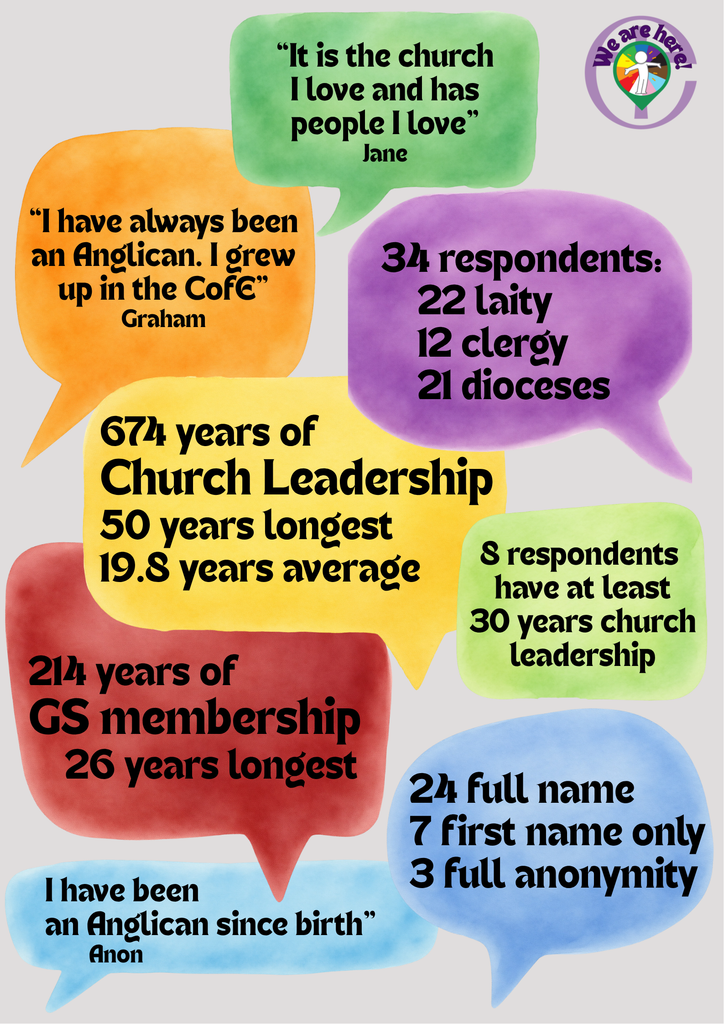
This report is based on responses from 34 people who served on General Synod during the last five years. Thirty-two were diocesan elected members – which alone indicates a level of commitment and respect among peers, alongside a Cathedral Dean and a representative of a Religious Community.
Twenty-two of us were lay people and 12 were clergy. Together, we bring 214 years of General Synod experience and 674 years of church leadership, with a quarter of those having given 30 years or more. Of the 34, 24 people chose to be named in full, 7 chose to only use their first name and 3 opted for full anonymity. And for some it was simply too soon after the latest Synod vote to re-engage.
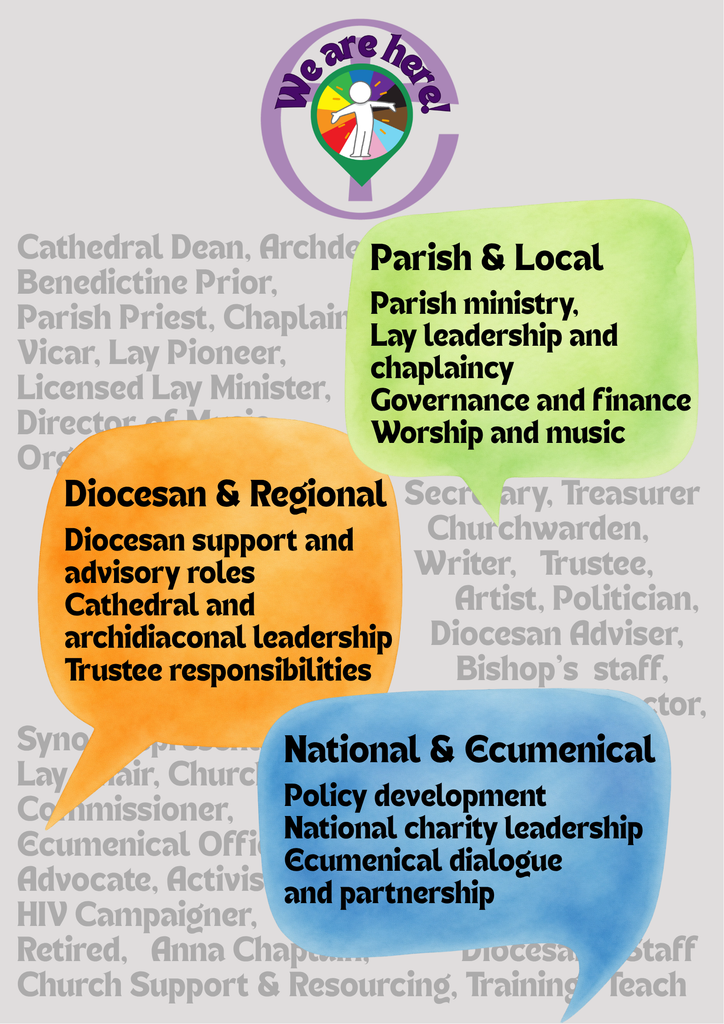
We have experience across parish, diocesan and national church life, including clergy, churchwardens and PCC officers, finance and music leadership, licensed lay ministry and chaplaincy, diocesan advisers and support staff, cathedral and archidiaconal leadership, lay governance roles, and national and ecumenical leadership.
During the collation and analysis of responses for this report, we considered the entire membership of Synod. Currently, there is no official data collection done about sexuality of Synod members. This is particularly interesting when we consider the stated intention of the CofE wanting to be more diverse. If data isn’t tracked and taken, any conclusions are guesswork and have to be based on assumptions, which is less than reliable. There is a reluctance to collect this data and ask these questions. Whether people would feel able and comfortable to be honest if these questions were asked, is a question to be explored and considered elsewhere. But we were interested to consider the numbers in a broader context, so we analysed the list of synod members and our personal knowledge and insight of members. From this we are able to say that we estimate around 15% of Synod, in every house, that are LGBTQIA+. Half of whom responded to the invitation to contribute to this report. 80% of those who are ‘out’ replied.
These numbers are not insignificant. But numbers are not the point of this report.
People are. Because each number, each year, tells a story. Behind each number a life has been given to the Church. There are faces, names and stories behind those numbers. Stories of time, gifts and commitment given to the Church we are called to serve, and strive to love.
A Church We Love – and a Church That Has Hurt Us
Many of us speak of the Church of England with profound affection. It is our spiritual home. It is where many of us first encountered God. It is a community in which we have found friendship, vocation, belonging and purpose. Some of us have given twenty, thirty, even fifty years of our lives to the Church. We have preached and taught, led worship and walked alongside the most vulnerable members of our communities, in the most challenging times of their lives. We chair committees, contribute to musical life, mentor young people and lead outreach.
We remain in the Church of England, stubbornly, because we love the people and communities to which we belong, and are called to serve. Our identity is grounded in the Church of England. We feel we belong here. We believe that God is not finished with the Church of England, and that God is asking us to stay. Yet alongside this sits a deep pain.
Some could only respond to this invitation anonymously. Some are too hurt, too angry or let down to speak openly, or even speak at all on this topic. Some have stepped back from ministry because the cost became unbearable. Some have left the Church of England entirely.
The fact that people who have given so much to the Church can reach a point where they feel unable to remain is significant.
Our stories reveal a contradiction the Church can no longer ignore: General Synod has stated that homophobia is wrong, and that disadvantaging people because of their sexuality or gender identity is unacceptable. Yet many of us continue to experience exclusion, rejection, and harm, on a regular basis.
Some of us have been repeatedly bullied, sidelined, denied ministry, silenced or treated as lesser. Several of us describe being traumatised by Synod itself. For many of us, the behaviour of the bishops has been experienced as a profound betrayal, a failure of pastoral care at the moment it was most needed. Which would have cost them little, but made a huge difference to so many. The pain is real. The harm is real. And it has to stop.
One of the things we want to be clear about is that we honour genuine diversity of opinion within the Church. We have long lived, worked, and ministered alongside people whose theological convictions differ from our own. We do not seek uniformity. We do not demand that everyone agree with us. Or that all LGBTQIA+ must seek romantic relationships. We value the breadth of the Church of England, and we want a Church in which people of different convictions can flourish and belong.
But we are also clear that diversity cannot be honoured when it becomes a justification for harm. Honouring difference does not mean tolerating discrimination. Honouring conscience does not mean allowing harm.
The pain caused by actively diminishing people’s humanity is not equivalent or as valid as being put out that someone might be allowed to exist and make choices you don’t like. Respecting another person’s theological conviction does not require us to surrender our own dignity, freedom or safety.
The 34 of us who responded to this project are only a portion of the LGBTQIA+ people who have served on General Synod. There are more of us, and there are far more LGBTQIA+ people across the Church more widely. But there are also many who have left. People whose voices we do not, and cannot, hear. Some have slipped away quietly; too tired, hurt, damaged to stay any longer. Some have given up on the Church. Some have not given up on God, but some have. Their absence matters too. We cannot talk honestly about the Church we are building if we only count the people who have managed to remain, or those who shout the loudest.
We can disagree about theology but when theological conviction is used to justify restricting the lives, relationships or ministries of other people it must be called out. When conversion therapy perpetuates harm, and when homophobic behaviour is allowed to continue despite the lessons repeatedly identified through safeguarding reviews, this is not simply a matter of theological disagreement. It is a safeguarding issue. It is a matter of power. And it must be treated as such.
Hope, Optimism, and the Work of Inclusion
Despite everything, the dominant tone of the 34 who replied was not despair but hope.
We remain because we believe in a future where the Church of England fully reflects God’s love for all people. We stay to work for change, to challenge injustice, and to help build a Church where LGBTQIA+ people are welcomed without hesitation or caveat.
But our vision of inclusion is not limited to ourselves. We care about the whole Church. We care about children and young people, about disabled people, about people living with mental ill health, about people with learning disabilities, about people experiencing poverty and economic injustice. We care about working class vocations. We care about racial justice, gender equality and identity, sexuality, and the many ways in which people’s lives and experiences intersect. We bring those concerns with us into our work on General Synod. We do not leave the rest of ourselves at the door when we enter Synod. Our experiences have taught us to notice who is missing, who is unheard, who is carrying more than they should have to, and who is being asked to wait for justice. We bring that awareness with us too.
When we speak about inclusion, we are not simply speaking about who we are allowed to love. When we speak about justice, we are not only speaking about ourselves and demanding accommodation. When we ask the Church to be more compassionate, more equitable and more attentive to the dignity of every person, we are asking that of the whole Church, for the whole Church.
Our experience of marginalisation has taught us something about what happens when the Church fails to see the whole person. Jesus was always concerned with the wholeness of people, their community, their choices and their commitments. Many of us emphasise that full inclusion and genuine orthodoxy are not opposites. We reject the false narrative that affirming LGBTQIA+ people requires abandoning Christian tradition. Instead, they see inclusion as a faithful expression of the Gospel, a calling rooted in Scripture, sacrament, and the life of Christ.
Our optimism is not naïve. It is resilient, hard-won, and grounded in decades of service.
We are here, because we believe the Church can be better, and we want to be part of making it better, we believe we are called to do this, not only for those like us, but for everyone.
Making It Personal. Making It Matter.
This report is titled We Are Here because visibility is transformative. When you see our faces, you see the people behind the debates. When you hear our stories, you hear a hint of the cost of exclusion and the strength of hope. When you recognise our names, you recognise the leaders, volunteers, and servants who make the Church of England what it is.
These photos are not decoration. Our names, our stories, our numbers. They are testimony. They are witness. They are truth.
We are here; in your parishes, your synods, your dioceses, your pews, your pulpits, your committees, your communities. We are here, deeply involved and invested in the life of the Church of England, not on the margins of it.
We are here because this is our home. We are here because God has called us. We are here because we believe the Church can be better, should be better. We are here because we intend to help build that future.
We are here. It is our church as much as anyone else’s, and we are not going anywhere.
Embedded & Involved
We have experience across parish, diocesan and national church life.We are clergy, churchwardens and PCC officers; with roles in finance and music leadership, licensed lay ministry and chaplaincy. Integrated into church life at every level as diocesan advisers and support staff, cathedral and archidiaconal leadership, lay governance roles, and national and ecumenical leadership
Nevertheless, we remain
We Are Here invited people to reflect on why they remain in the Church of England, and for some, why they have stepped away. Every response gathered for We Are Here is unique. Yet taken together there are recurring themes that are hard to tune out. Layered stories with threads that speak of faith and frustration, belonging and exclusion, love and disappointment.
They tell of people who have given decades of service to the Church, people who continue to hope for change, people who have found themselves wounded by the very community they love. They speak of God’s call, of home, of identity, of communities loved and served, the cost of sacrifice and compromise, and of a reckless, foolish hope that refuses to disappear.
Together, they form a powerful, testimony.
A testimony of people who remain because they believe God has called them here, as they are, as beloved children of God. As Robert Thompson put it: “LGBTQ+ people are guests at Christ’s table, gifts to be received, but also members of Christ’s body.”
These stories are not simply about staying. They are stories about faithfulness, belonging, witness and resilience. The included artwork is composed from the quotes and words of those stories. With deliberate layering up and obscured elements to reflect the reality of our full stories only being known to God, but that there is still the possibility of beauty and blessing in what is known and shared.
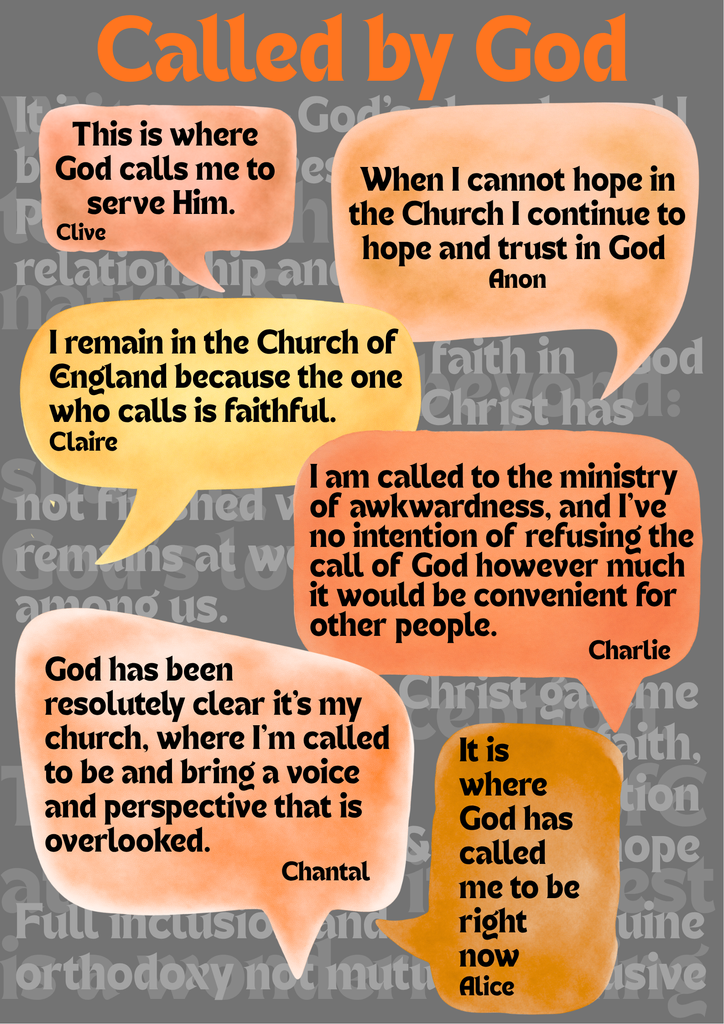
Called
Many spoke first not about the Church, but about God.
Again and again, the language of vocation emerged. Remaining was not described as a personal preference or institutional loyalty, but as a response to God’s call. Some spoke of ministry, others of witness, others of being a voice that might otherwise be overlooked. Beneath these different experiences lay a common conviction: that God had not stopped calling.
“The one who calls you is faithful.” 1 Thess 5.24
“I remain in the Church of England because the one who calls is faithful.” Claire Robson
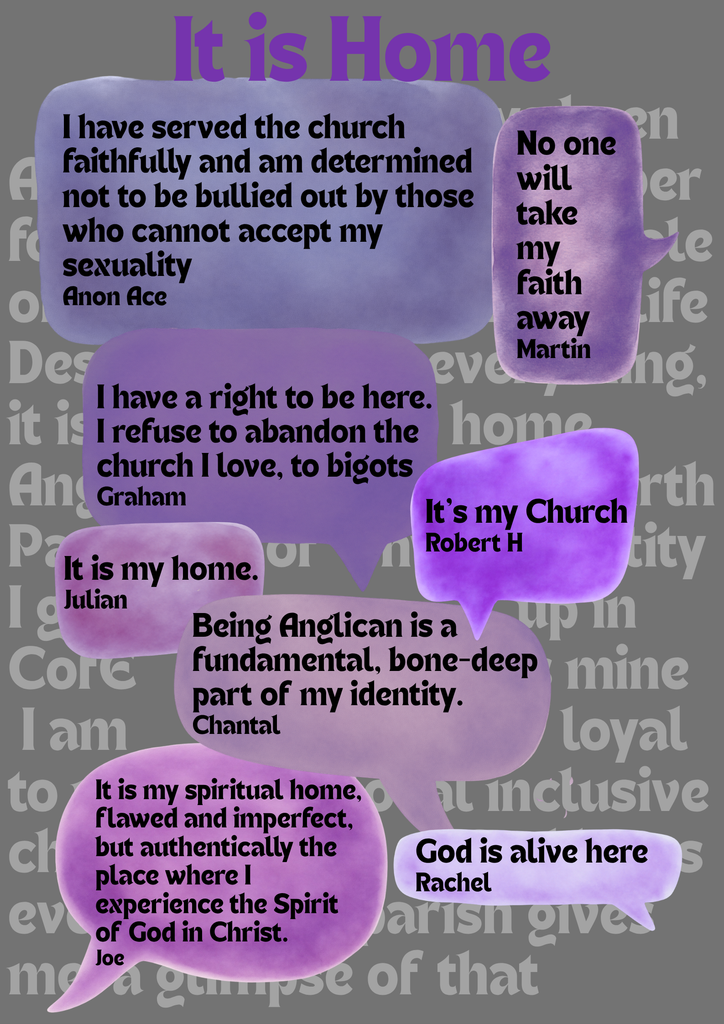
Home
For many, the Church of England is not simply somewhere they attend. It is woven into memory, identity and belonging.
People spoke of growing up Anglican, of lifelong membership, of local churches and familiar liturgy. They described the Church as a place where faith was nurtured, where community was found, and where God’s presence continues to be encountered. Even when speaking honestly about imperfection and hurt, many still spoke of home.
“In my Father’s house are many dwelling places.” John 14.2
“It is my spiritual home, flawed and imperfect, but authentically the place where I experience the Spirit of God in Christ.” Joe Hawes
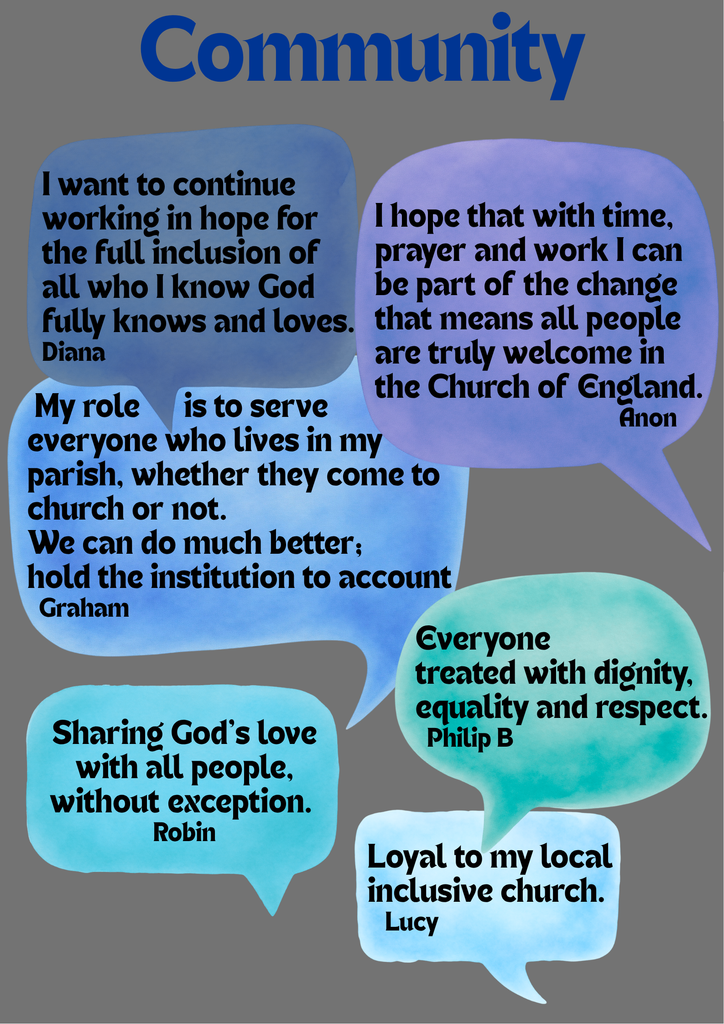
Community
Again and again, responses were about other people, rooted in care and concern for others.
The local church. The parish. Communion shared around the table. Neighbours, friends, congregations and communities. Many remain because they care deeply about the people among whom they worship, live and serve. There was a strong commitment to building communities marked by dignity, justice and inclusion, and a determination that nobody should be excluded and kept away from the love of God.
“We who are many are one body.” 1 Cor 10:17
“I want to continue working in hope for the full inclusion of all who I know God fully knows and loves.” Diana Tremayne
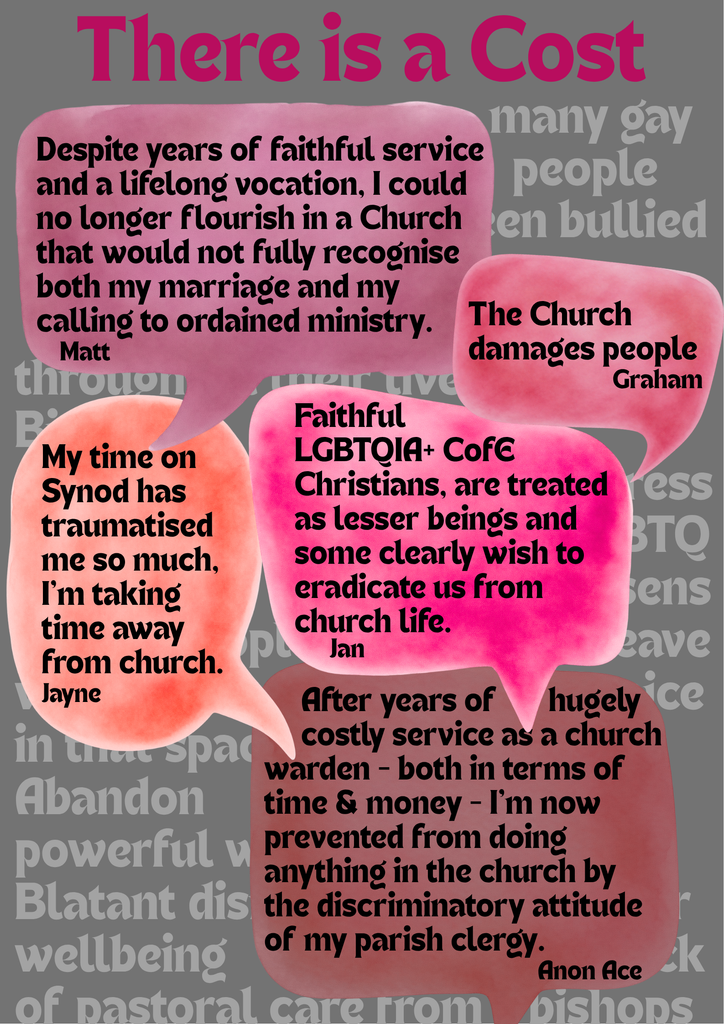
Cost
Alongside love and belonging sits profound pain.
Many responses spoke openly about rejection, exclusion, discrimination and trauma. Some described barriers to ministry. Some spoke of losing opportunities to serve. Others reflected on years of faithful service followed by experiences that left deep wounds.
For some, remaining has come at a significant personal cost. For others, that cost became too great. Some have stepped back to rest and heal. Some have left the Church of England entirely. Their voices are part of this story too.
“Come to me, all you that are weary and are carrying heavy burdens, and I will give you rest.” Mtt 11.28
“Despite years of faithful service and a lifelong vocation, I could no longer flourish in a Church that would not fully recognise both my marriage and my calling to ordained ministry.” Matthew Edwards
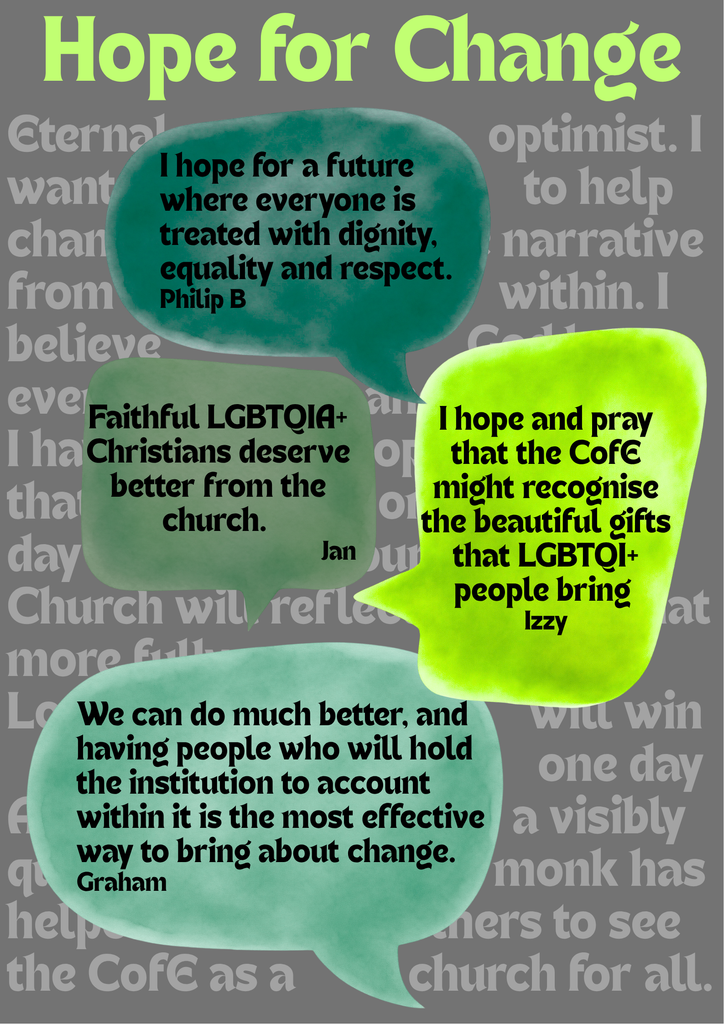
Hope
Yet the final note is not despair.
Despite a lot of pain, there was also a prevalent sense of stubborn, resilient hope. Hope that the Church can change. Hope that inclusion and orthodoxy do not, and need not stand opposed to one another. Hope that future generations might know a Church where LGBTQIA+ people are fully recognised, affirmed and celebrated.
This hope is not rooted primarily in institutions, policies or structures. It is rooted in faith; theologically based, prayerfully discerned and scripturally reasoned.
“God is love, and those who abide in love abide in God, and God abides in them.” 1 John 4:16
“I hope and pray that the CofE might recognise the beautiful gifts that LGBTQI+ people bring.” Izzy
act justly, love mercy, walk humbly…
Across the 34 responses that were offered, which we estimate to be about half of the LGBTQIA+ members who served on General Synod over the last quinquennium, diverse experiences, vocations, skillsets and perspectives were represented. These voices represent decades of ministry, service, witness, worship and prayer. They include clergy and laity, musicians and monks, churchwardens and synod members, people who remain, people who have stepped back, and people who have left.
The decision to remain is not one we only make once, it is one we consider, and reconsider on a regular basis. Weighing up whether the cost is too great, or is able to be balanced out by the positives and blessings we receive by staying.
When synod is hardest, and debates the most bruising, it is the community and shared care that has held many of us together. The five interconnected reasons described and explored above came across loud and clear in the responses gathered.
They do not all tell the same story. But they share a common conviction: that LGBTQIA+ people are part of the Church, have always been part of the Church, and have gifts, vocations and experiences that matter. We believe and know this to be true. To us, and to God. We are invited and there is a place for us at the table. Even if that is not yet what we are hearing from the Church of England.
We are here.
Called by God.
At home in the Church.
Loving our communities.
Bearing the cost. Holding on to hope.
The Synodical Journey: Living in Love and Faith, Through the Quinquennium
An account shaped by the experiences of LGBTQIA+ members of General Synod, 2021–2026.
The promise of listening
When Living in Love and Faith (LLF) began, many of us wanted to believe that something important might be changing. Here was an invitation to listen to LGBTQIA+ Christians, to hear our stories and take seriously the lives behind the theological arguments. Around 700 people had contributed to the research and resources, sharing experiences that were often deeply personal and sometimes painful to tell.
Many of us knew that telling our stories would not automatically mean being heard. But we hoped that listening might make a difference: that people might encounter one another differently, question what they thought they knew, and begin to imagine a Church in which we could belong without having to explain, defend or apologise for who we are.
The process encouraged churches to explore the resources, listen to one another and engage in conversation. There was real potential here. We hoped that people would listen with open minds and open hearts, allowing themselves to be changed by what they heard.
But stories about sexuality, gender and relationships are never simply abstract theological exercises. They are stories about our lives, our relationships, our families and our faith. When someone questions the validity of your relationship or the integrity of your identity, it is not an academic disagreement. It reaches into who you are. It’s personal.
Some of us encountered genuine curiosity and a willingness to listen. Others experienced dismissal, misunderstanding or the sense that our lives were being treated as a problem to be solved. We knew that the invitation to listen was only a beginning. We hoped it would lead somewhere.
A door opened
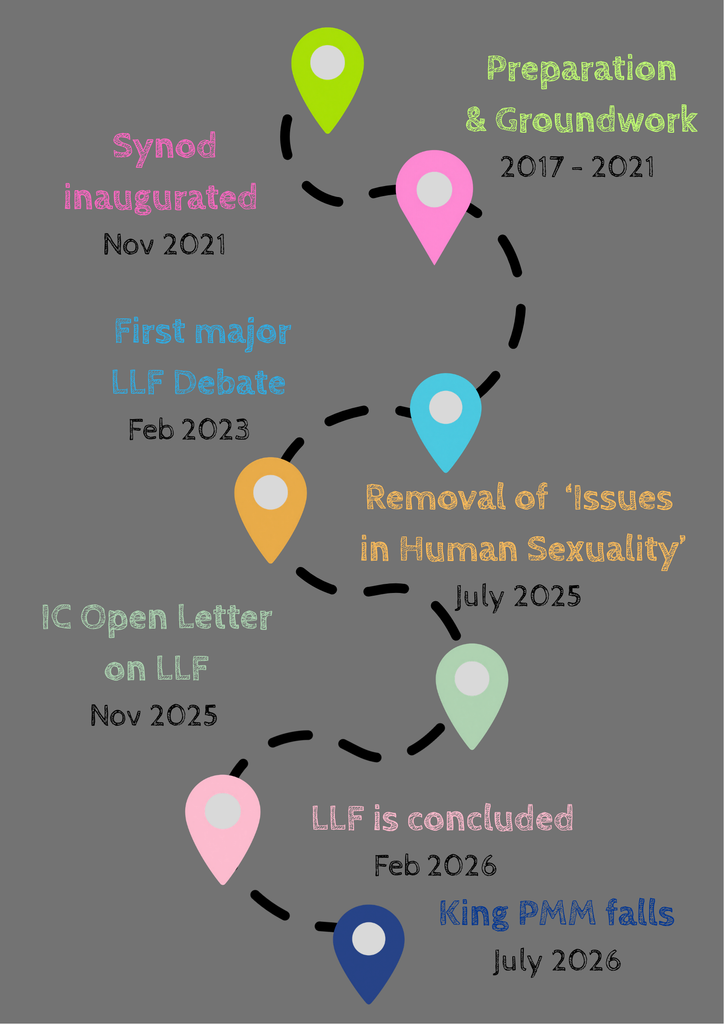
By February 2023, the listening exercises, diocesan conversations and theological work had led to a significant moment at General Synod.
The House of Bishops brought forward proposals that included the Prayers of Love and Faith (PLF), and Synod voted to introduce them.
For many of us, this was a historic step. Same-sex couples could receive public prayers of thanksgiving, dedication and blessing within regular services. Something that had previously been denied was now possible.
But it was also a compromise. The prayers did not change the Church of England’s doctrine of marriage, and they fell short of what many of us had hoped for. A door had opened, but only a crack.
We hoped that this would be the beginning of further progress. Instead, the following years brought repeated debates about what could be permitted, where the prayers could be used and what further changes might be possible. The questions were procedural and theological, but the consequences were personal. Each delay and restriction had an impact on real couples and real communities.
Many of us had already given years to this process. We had shared our stories, participated in consultations and trusted that our experiences would inform the Church’s discernment. We wanted to believe that the Church was learning how to listen differently. Too often, it was difficult to see how what we had shared had shaped the decisions being made.
Compromising Circumstances
In July 2025, Synod voted to replace Issues in Human Sexuality. For many, this was a significant moment: an acknowledgment that the Church needed to move beyond a document associated with profound harm, both to LGBTQIA+ people and to others affected by its application.
Yet the decision also highlighted how long such change had taken, particularly as the document had assumed a status and function beyond those originally intended or authorised.
Even as some things changed, the wider process continued to feel marked by caution, negotiation and the management of disagreement, or perhaps more accurately, a bartering of compromises. The vote that finally got Issues removed saw cooperation and coalescence across faction boundaries. But the motivations came from starkly different places and it was also used as a appeasement for the lack of progress on actually blessing and/or marrying same-sex couples.
We could recognise progress while still asking whether the Church was prepared to confront the deeper questions of power, belonging and the treatment of LGBTQIA+ people within its own life.
In autumn 2025, Inclusive Church’s Open Letter demonstrated the breadth of feeling across the Church. Thousands of people signed the letter, from thousands of churches, making clear that the desire for a more inclusive Church was not confined to a small group. The letter, its accompanying report and summary tell that story in greater detail.
The letter articulated something of the frustration, sadness and commitment for many who had not previously been given a voice or offered a space to speak. The pervasive apathy and assumption that progress is inevitable, so we can sit back and trust the process, is starting to be recognised as an untruth.
The Reckoning
By February 2026, Synod was being asked to bring the LLF programme to a conclusion. The motion recognised and lamented the distress and pain many had suffered, especially LGBTQIA+ people. It thanked those who had worked on the process and established new structures to continue work on relationships, sexuality and gender.
There was something important in naming the harm. But many of us were left wondering what it meant to acknowledge that harm while the questions that had caused it remained unresolved.
Had we learned to listen differently? Had the Church become better at recognising the humanity of people whose lives and relationships it had spent years debating? Had our participation changed the way decisions were made, or had we simply become more practised at enduring the process?
I cannot answer those questions on behalf of everyone. But the reflections shared by the 34 LGBTQIA+ Synod members who responded to this project show why the answers matter. Our experiences were not all identical, and we did not necessarily interpret every moment in the same way. Yet the process had touched us personally. It was not something happening at a distance, to somebody else, it never has been.
We were members of the body making these decisions. We were part of the Church whose future was being discussed. We were not asking to be treated as a special interest group outside its life, but to belong within it without having to deny or apologise for who we are.
Then came July 2026.
A motion offering a relatively modest pastoral affirmation of the dignity and worth of LGBTQIA+ people was amended and ultimately defeated in the House of Bishops by just two votes. For many of us, this was devastating. After years of participation, compromise and assurances that our voices had been heard, it was difficult not to ask what that listening had actually changed.
How many more times would we be asked to wait, to compromise, to trust the process and to absorb the hurt when it failed to deliver?
We knew that the Church was not of one mind. We had never imagined that every disagreement would disappear. But many of us hoped that, even where theological differences remained, there could be a shared commitment to affirming our dignity and recognising our place within the Church. The vote on the King PMM exposed just how fragile that hope remained.
It was not simply disappointment about one motion. For many of us, it deepened a breach of trust that had been growing over many years. The language of unity and walking together is hard to hear when some of us continue to experience the cost of that unity in our own lives, sometimes even with our lives.
Additional background & sources of extra info:
- Article by Tim Wyatt, 2020 RMC factsheet
- LLF resource hub resource hub (CofE)
- One page summary of LLF from Anglican Futures
- Legal position and process around PLF from Together for CofE
- Official CofE October 25 update
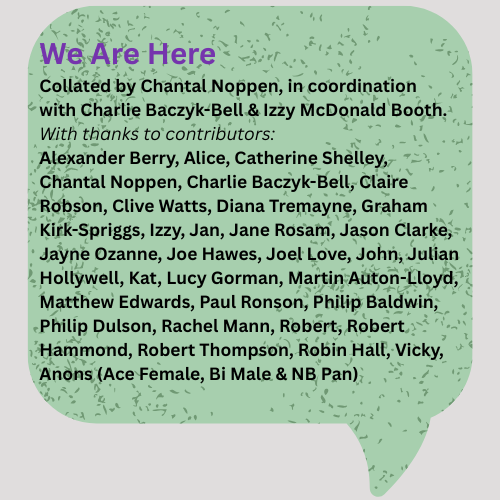
I am grateful to all those who took the time to share their stories with me, and respect those who felt unable to. This is not every story. But it is part of our story. And it should be heard.
Methodology
The We Are Here responses were gathered through an optional Google Form, shared by word of mouth, via WhatsApp and Facebook, and through personal and professional networks. Some people were also asked to pass the invitation on to specific individuals, although it is not possible to know how widely this happened. In retrospect, a direct invitation to the whole General Synod membership might have been worth trying in order to gather the most responses and reach more people; however, the smaller-scale approach was considered more likely to foster trust and encourage participation.
Participation was entirely voluntary.
Some LGBTQIA+ people had moved on during the quinquennium and were no longer in the relevant WhatsApp group, while others were not readily contactable through Facebook. Others may have chosen not to respond, for reasons we cannot know and should not presume.
Given the potentially sensitive nature of sharing personal experiences, the intention was to offer an invitation rather than create any sense of pressure or obligation, recognising that trust can be precarious. The resulting 34 responses do not claim to represent every LGBTQIA+ person at Synod, but they offer something valuable in their own right:
real people, real voices and lived experiences that might otherwise remain unseen or unheard.
Participants were invited to submit a photograph and provide basic information about their service on General Synod, together with optional demographic information and preferences regarding how they wished to be represented within the project.
Particular care was taken to ensure that participation could be undertaken at a level people considered safe and comfortable. Contributors could choose whether and how they were identified, including options for anonymity or blurred images, and were free to answer only those questions they wished to answer.
A key principle of the project was that participants should retain agency over how they were represented. For that reason, contributors were offered a range of options concerning naming, anonymity and visual representation.
Notably, every option provided was used. While respondents were not asked to explain their choices, some voluntarily shared their reasons. These included concerns about family acceptance, as well as feelings of vulnerability or uncertainty about how openness regarding their sexuality or gender identity might be received within their diocese or church context.
As with any voluntary survey, responses reflect the experiences of those who chose to participate, and it is possible that individuals who felt particularly strongly may have been more likely to respond. Equally, we are aware of a number who chose not to participate because the pain felt too fresh.
All submissions were reviewed prior to publication to ensure that contributors’ chosen levels of anonymity were respected.